
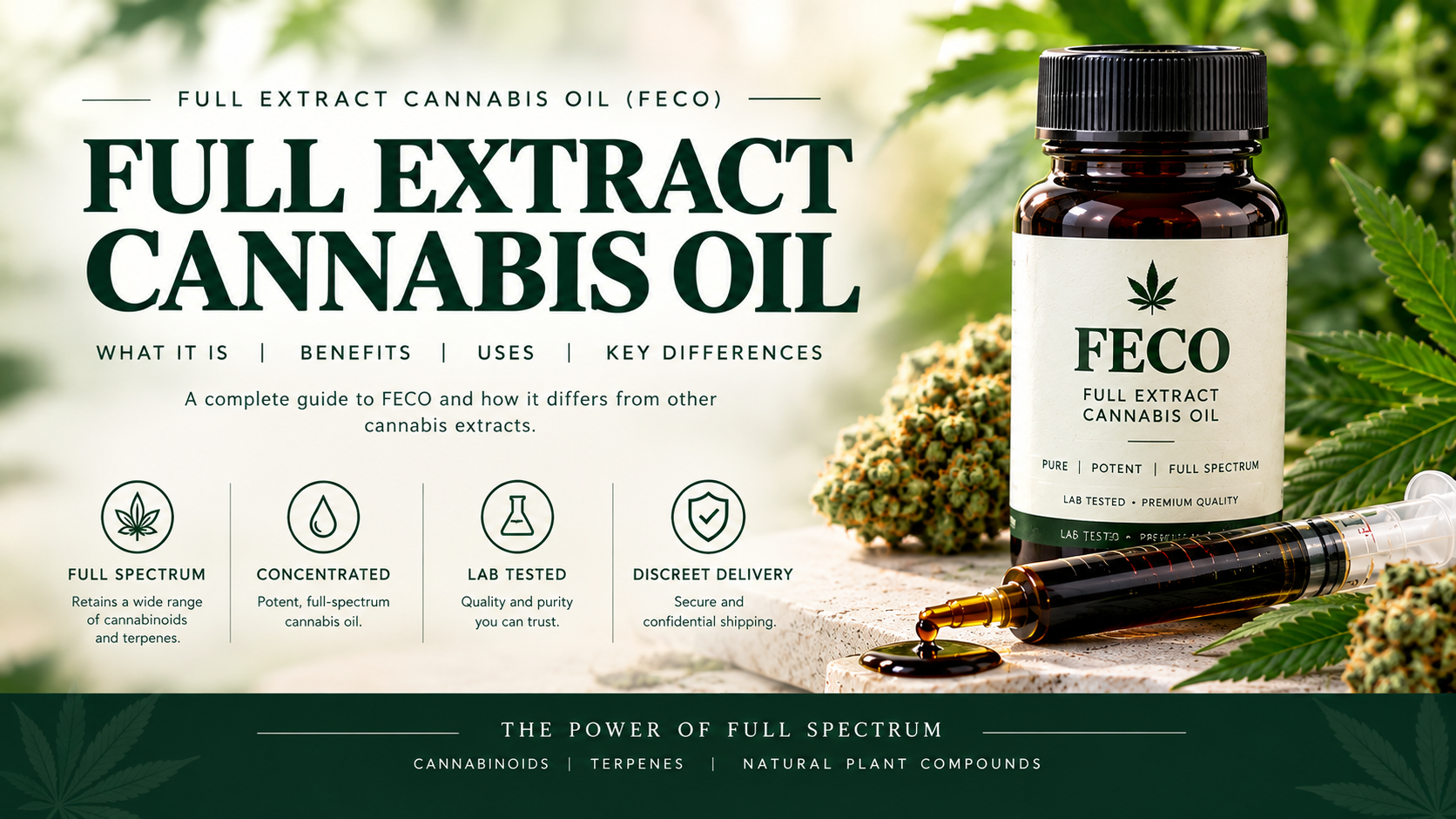
Full Extract Cannabis Oil: Meaning, Types, and Safety
The phrase full extract cannabis oil describes a category of cannabis-derived oils, but it does not identify one universally standardized product. The term is used in discussions of concentrated extracts that may retain a range of compounds from cannabis plant material. The precise meaning can vary between manufacturers, sellers, and educational sources.
Understanding this terminology requires looking beyond the product name. Extraction, refinement, formulation, and quality-control practices can produce oils with different chemical profiles and physical characteristics. Labels may also use terms such as *full-spectrum*, *whole-plant extract*, *distillate*, and *concentrate*, which are related but do not necessarily mean the same thing.
This guide explores how the term full extract cannabis oil is used, how extract categories differ, what processing terminology can tell you, and how to assess product descriptions critically. It also covers safety considerations and the limits of claims made about concentrated cannabis products.
This article is for general educational purposes. It is not medical advice or a recommendation to use cannabis to prevent, diagnose, treat, or cure a health condition.
What Does Full Extract Cannabis Oil Mean?
Full extract cannabis oil is a descriptive phrase rather than a single internationally standardized formulation. It generally refers to an oil produced by extracting substances from cannabis plant material, with the intention of retaining a mixture of plant-derived compounds.
The word *full* can suggest that an extract retains a broad range of compounds, but it should not be interpreted literally as proof that every naturally occurring substance from the plant remains in the final product.
Extraction and refinement involve choices about which compounds are collected, which are removed, and how the material is processed. Some substances may be present in the original plant but absent or present only in small amounts in the finished oil.
There is also no universal composition implied by the phrase. Two manufacturers may use similar terminology for products made through different processes or with different cannabinoid profiles.
For a related explanation of FECO terminology, see our guide to FECO. Although the terms can overlap in common usage, a product's actual characteristics depend on its production and documentation rather than its name alone.
Why Cannabis Extract Terminology Can Be Confusing
Cannabis product descriptions often combine several types of terminology. Some words refer to the source material, some describe processing, and others identify a formulation or delivery method.
These categories are not interchangeable.
For example, a product might be described as full-spectrum, which generally refers to an extract intended to retain a range of cannabis compounds. Another might be described as a distillate, referring to a type of refined extract. A tincture, meanwhile, describes a liquid formulation or delivery format rather than one particular extraction method.
A single product description may combine several of these terms. The important question is what the manufacturer means by each term and whether supporting information is available.
Extract category versus product formulation
An extract is material obtained by separating compounds from a source material. A formulation is the finished product prepared for a particular format or intended route of administration.
An extract may be used as an ingredient in a formulated product, but the two terms describe different stages or aspects of the product.
For example, an extract might be incorporated into a carrier oil or another preparation. The resulting product's concentration, ingredients, and physical properties can differ from those of the original extract.
This distinction matters when reading product labels. Information about an extract alone may not fully describe a finished formulation.
Marketing terminology versus measurable characteristics
Words such as *premium*, *complete*, *pure*, and *high strength* may appear in product descriptions. Unless they are supported by clear definitions and verifiable evidence, they do not establish a specific chemical composition or quality standard.
More useful information includes an identifiable manufacturer, a complete ingredient list, clearly stated cannabinoid measurements, batch identification, and relevant laboratory documentation.
Even these details have limitations, but they provide a stronger basis for assessment than promotional language alone.
How Cannabis Extraction and Refinement Affect an Oil
Cannabis extracts can differ because of the starting material, extraction technique, and subsequent processing. The general term full extract cannabis oil does not reveal every detail of how a particular product was manufactured.
Starting material
The source material influences which compounds are available to be extracted. Cannabis plant material can vary in its chemical profile between varieties, growing conditions, harvests, and batches.
Handling and storage before processing may also affect the material's condition. Consequently, products made from different source batches may differ even when the manufacturer follows a similar general procedure.
A product name cannot establish the exact characteristics of its source material.
Extraction
Extraction separates selected substances from plant material. Different techniques use different physical or chemical conditions, and these can influence the composition of the resulting extract.
The choice of method alone does not establish the final product's quality. Appropriate processing controls, equipment, handling, and testing are also relevant.
A description that names an extraction method may provide useful information, but it does not independently confirm potency, purity, or the absence of unwanted substances.
Refinement and filtration
Some extracts undergo further processing after the initial extraction. Depending on the process, refinement may change the relative proportions of compounds, remove selected constituents, or alter the physical characteristics of the material.
Filtration and other separation steps can also influence which substances remain. The result depends on the particular process and its operating conditions.
It is therefore inaccurate to assume that every product described as a full extract has undergone the same degree of refinement—or that all products with minimal refinement have identical compositions.
Formulation and packaging
After extraction and any refinement, a product may be formulated, packaged, and labelled for sale. Additional ingredients may affect its texture, stability, concentration, or intended format.
Packaging and storage conditions also matter because environmental exposure can contribute to changes in some cannabis-derived compounds over time.
The finished product should be evaluated using its own label and supporting documentation rather than assumptions based on the extraction process alone.
Full Extract, Full-Spectrum, and Whole-Plant Extracts
These expressions are sometimes used in similar contexts, but they should not automatically be treated as synonyms.
Full extract
*Full extract* is commonly used to suggest that a cannabis extract retains a broad mixture of plant-derived compounds. However, the term does not specify a universal list of compounds that must be present or a fixed concentration for any of them.
The phrase may also be used differently by individual manufacturers. Product-specific information is needed to understand what the description means in a particular case.
Full-spectrum extract
*Full-spectrum* generally describes an extract intended to retain multiple naturally occurring compounds from the source material rather than isolate only one selected compound.
The exact meaning and applicable labelling rules can vary by jurisdiction and product category. The term alone does not establish that every compound is present, that the product has a particular THC level, or that its composition is identical to another full-spectrum product.
A laboratory report can help clarify which cannabinoids were measured in a tested sample.
Whole-plant extract
*Whole-plant extract* is commonly used to indicate that an extract was produced from cannabis plant material with the aim of representing a broader range of its constituents.
However, the phrase does not guarantee that every part of the plant was used, that all plant compounds were retained, or that the final product contains a complete representation of the original plant.
Manufacturing details and product-specific documentation are needed to interpret the claim.
Isolated and highly refined extracts
Some cannabis products are processed to concentrate a selected cannabinoid or group of compounds. Isolates and highly refined extracts can differ substantially from extracts intended to retain a wider mixture of plant constituents.
These are different approaches to producing cannabis-derived ingredients, not a simple ranking of good versus bad products. The suitability and quality of a particular product cannot be determined from the category name alone.
When comparing labels, identify the actual compounds reported, the quantities stated, and the product's formulation.
Does Full Extract Mean a Product Is More Complete or More Effective?
No such conclusion follows from the term alone.
The word *full* may suggest a broader mixture of compounds, but it does not establish that an extract contains every compound found in the original plant. Nor does it demonstrate that the product produces better outcomes than a more refined extract.
Claims about the comparative effectiveness of cannabis products require appropriate evidence for the specific product, formulation, use, and outcome being discussed.
Research on one cannabinoid, one standardized medicine, or one preparation cannot automatically be applied to all cannabis oils. Product composition, route of administration, and study design can all affect how findings should be interpreted.
Terms such as *whole plant*, *full extract*, or *full spectrum* should therefore be understood as descriptions that require context—not as proof of a particular medical benefit.
Be cautious when a product description claims that retaining more plant compounds guarantees a stronger effect, superior results, or treatment of a specific disease. Such claims need credible evidence and must comply with applicable regulations.
How to Interpret Product Concentration and Composition
The terms used to describe an extract do not tell you how much of a particular cannabinoid is present. Concentration and composition are separate questions that require product-specific information.
Concentration is not the same as package weight
The total weight of an oil is not the same as the quantity of THC, CBD, or another cannabinoid contained in it.
A package may state a total product weight, a cannabinoid concentration, or a total cannabinoid amount. These values describe different measurements and should not be compared as though they were interchangeable.
Check the units and determine whether a stated quantity refers to the entire package, a specific mass of product, or another defined amount.
Labels need context
A label may use percentages, milligrams, or other units to report cannabinoid content. A percentage cannot be interpreted accurately without understanding what it measures, while a total milligram amount needs to be considered alongside the quantity of product.
Labels should also identify the relevant cannabinoid where possible. A statement about total cannabinoids is not necessarily the same as a statement about THC.
If the units, testing basis, or reported cannabinoid are unclear, avoid making assumptions about the product's strength.
Product format matters
An oil, tincture, capsule, edible, or other finished preparation may have a different formulation and concentration. The volume of a liquid does not by itself establish the mass of extract or the amount of a particular cannabinoid in a portion.
For information specifically about FECO measurements and dosage-related safety, consult our FECO dosage guide when available. That page has a different purpose from this terminology guide.
What Laboratory Reports Can and Cannot Confirm
Laboratory documentation can help clarify the measured composition of a tested cannabis product. It should be interpreted as evidence about the sample and the analyses performed—not as a universal guarantee of product quality or suitability.
Identify the product and batch
Check whether the report identifies the product and batch being evaluated. A report for a different product, an unrelated batch, or an unidentified sample may not establish the composition of the item in question.
Where available, compare product identifiers and dates on the report with the product's packaging.
Review the reported tests
A laboratory report may contain cannabinoid measurements and results for selected contaminants. The scope depends on the laboratory, testing programme, and applicable requirements.
Do not assume that a report covers every possible contaminant or quality issue. Check which tests were actually performed and how the results are expressed.
Understand the limits of a certificate
A Certificate of Analysis (COA) reports findings for a tested sample. It does not necessarily demonstrate that every package from a batch is identical, that every relevant substance was tested, or that a product is suitable for every person.
The reliability and usefulness of a report also depend on factors such as the laboratory's methods, quality controls, and the clarity of the report.
Read our Certificates of Analysis guide for more information about interpreting product testing documentation.
Safety Considerations for Concentrated Cannabis Oils
Concentrated cannabis products can contain substantial amounts of cannabinoids. Their effects and risks depend on the actual composition, formulation, route of exposure, and individual circumstances.
Impairment and unwanted effects
THC can affect attention, memory, coordination, reaction time, and judgment. Some people may also experience anxiety, panic, dizziness, confusion, or a rapid heartbeat.
The degree of impairment varies. A product's name, colour, texture, or marketing description cannot reliably predict an individual's response.
Do not drive or operate machinery while impaired, and follow applicable laws and product safety instructions.
Delayed effects after ingestion
When THC is swallowed, effects may take longer to appear and may last longer than effects from some other routes of administration. Timing varies with the product, formulation, food intake, and individual physiology.
Not noticing an immediate effect does not prove that a product has had no effect. Taking additional amounts too soon can increase the risk of unwanted or excessive effects.
Avoid relying on generic online descriptions as a substitute for product-specific instructions and qualified professional guidance.
Medicines and individual circumstances
Cannabinoids may interact with certain medicines or contribute to unwanted effects when combined with alcohol or other substances.
Anyone taking prescription medicines or managing a health condition should consult a qualified healthcare professional or pharmacist before using cannabis products.
People who are pregnant, planning pregnancy, or breastfeeding should avoid cannabis use and discuss relevant questions with a qualified healthcare professional.
Safe storage
Keep concentrated cannabis oils in clearly labelled packaging, securely out of the reach and sight of children and pets. Do not leave them in accessible locations or transfer them into containers that could be mistaken for food or medicine.
Accidental ingestion can cause serious illness, particularly in children. If a child may have ingested a cannabis product, seek urgent medical advice. If a pet may have ingested one, contact an appropriate veterinary service.
Claims about medical treatment
A product description or customer testimonial is not sufficient evidence that a cannabis extract treats or cures a disease.
Evidence for cannabis-based medicines varies according to the specific product, condition, formulation, and clinical research available. Findings for a regulated medicine or isolated cannabinoid do not automatically apply to every concentrated cannabis oil.
Do not replace prescribed treatment with a cannabis extract without discussing the decision with a qualified healthcare professional.
Common Misconceptions About Full Extract Cannabis Oil
Several common assumptions can make cannabis product descriptions harder to evaluate.
“Full extract” means every plant compound is present
Not necessarily. Extraction and processing can remove, change, or concentrate different substances. The term does not guarantee a complete inventory of compounds from the original plant.
A darker oil is always more concentrated
Colour is not a dependable measurement of cannabinoid concentration. Appearance can be influenced by source material, processing, formulation, and storage.
A visual comparison cannot establish which product contains more THC or CBD.
A more refined product is always purer
Refinement can change the composition of an extract, but the degree of processing alone does not establish product quality. Relevant laboratory results and manufacturing controls are needed to evaluate particular quality concerns.
A laboratory report guarantees the entire product is safe
A report only addresses the sample and tests covered by that report. It cannot establish that every possible contaminant has been assessed or that a product is appropriate for every individual.
Similar names mean identical products
Two products may use similar terminology while differing in formulation, cannabinoid content, manufacturing practices, or testing. Read the product-specific information instead of relying on naming conventions.
Frequently Asked Questions
Is full extract cannabis oil a standardized product?
No universal formulation is established by the phrase alone. Products sold under similar descriptions may differ in source material, processing, cannabinoid profile, and formulation.
Is full extract cannabis oil the same as full-spectrum oil?
Not necessarily. The terms may overlap in common usage, but their meanings can vary by manufacturer and product category. Check the product description and laboratory documentation to understand what is actually being claimed.
Does full extract mean the oil contains every cannabinoid?
No. The term does not guarantee the presence of every cannabinoid or other plant constituent. The actual composition depends on the source material and manufacturing process.
Does full extract cannabis oil always contain THC?
No conclusion can be drawn from the term alone. THC content varies between products, so consult the product label and relevant laboratory report.
Can appearance confirm the quality of an extract?
No. Colour, thickness, and smell cannot reliably establish cannabinoid concentration, purity, or the absence of contaminants. Product identification and appropriate testing provide more useful evidence.
What is the difference between an extract and a formulation?
An extract is material obtained by separating compounds from source material. A formulation is the finished preparation, which may include an extract along with carrier ingredients or other components.
Does a Certificate of Analysis prove that a product is safe?
A COA provides results for a tested sample and the tests performed. It can support an assessment of certain characteristics, but it is not a universal guarantee of safety or suitability.
Is full extract cannabis oil legal everywhere?
No. Laws differ by country and region and may depend on cannabinoid content, product category, and intended use. Check the laws that apply to your location rather than assuming that online availability means a product is legal.
Final Thoughts
Full extract cannabis oil is a descriptive term used for cannabis-derived oils intended to retain a range of plant compounds. It does not, by itself, define a fixed manufacturing method, a complete chemical profile, a specific potency, or a standardized level of quality.
Understanding the difference between extract terminology, refinement, formulation, and measured composition makes product descriptions easier to evaluate. Labels and laboratory documentation can provide useful evidence, but their meaning depends on the details they actually contain.
Treat broad marketing claims cautiously, consider the potential risks of concentrated cannabis products, and seek qualified advice when health or medication questions arise.
For further reading, explore our guides to FECO, RSO vs. FECO, and Certificates of Analysis.