
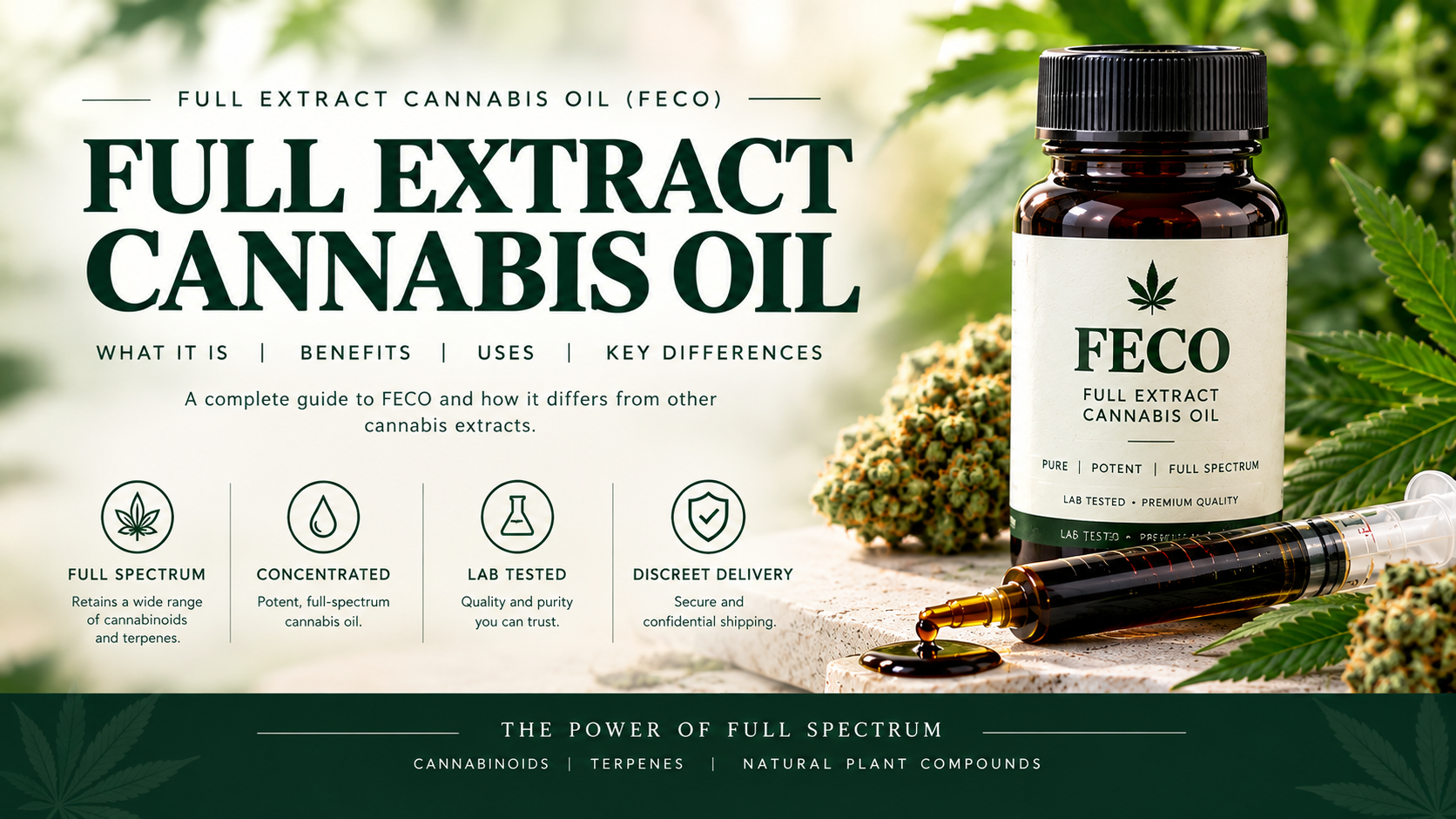
FECO: What Is Full Extract Cannabis Oil?
Full Extract Cannabis Oil, commonly known as FECO, is a concentrated cannabis extract made from cannabis plant material. The term is used to describe oils that may contain cannabinoids and other plant-derived compounds, but the composition and potency of individual products can vary considerably.
FECO is often discussed alongside Rick Simpson Oil (RSO), another term associated with concentrated cannabis extracts. Although the names are sometimes used interchangeably in online discussions, they do not guarantee identical manufacturing methods, cannabinoid profiles, or product quality.
Understanding FECO begins with knowing what the term means, how cannabis extracts can differ, what product labels actually tell you, and why laboratory testing matters. It is also important to separate established information about cannabis chemistry from claims about medical benefits that may not be supported by adequate clinical evidence.
This guide explains FECO terminology, cannabinoid composition, extraction considerations, product documentation, and important safety issues. It is educational information, not medical advice or a recommendation to use cannabis for a particular condition.
What Does FECO Stand For?
FECO stands for Full Extract Cannabis Oil. It is a term commonly used for concentrated oils produced by extracting compounds from cannabis plant material.
Depending on the starting material and manufacturing process, an extract may contain varying amounts of tetrahydrocannabinol (THC), cannabidiol (CBD), other cannabinoids, and additional plant constituents.
The word “full” should not be interpreted as a guarantee that an oil contains every compound originally present in the plant. Extraction processes differ in what they remove, retain, or concentrate. Processing, filtration, storage, and the source material can also affect the final composition.
Likewise, the word “extract” does not establish a specific potency, purity level, or safety profile.
FECO is not a universally standardized formulation. Products sold under this name may differ in their cannabinoid concentrations, production methods, consistency, and available quality-control documentation.
For this reason, evaluating a particular FECO product requires more than looking at its name or appearance. Product-specific information is essential.
What Is FECO Made From?
FECO is generally produced using cannabis plant material as the source of the extract. The resulting oil can contain cannabinoids and other substances extracted from that material.
The exact composition depends on several factors.
Cannabis source material
The cannabinoid profile of the starting material influences the composition of the resulting extract. Cannabis varieties and individual batches can differ in their THC, CBD, and other cannabinoid levels.
Growing conditions, harvesting, drying, storage, and handling may also affect the material before extraction begins.
A product name alone cannot identify the precise composition of the starting material or establish the cannabinoid content of the finished oil.
Extraction and processing
Extraction methods differ in how they separate compounds from plant material. Processing decisions may influence which substances remain in the finished product and which are removed.
Manufacturers may also use additional processing, filtration, or formulation steps. These differences can affect the resulting extract's composition, appearance, and consistency.
Without reliable manufacturing information or appropriate laboratory results, it is not possible to determine the exact production method or composition of a FECO product from its appearance alone.
Storage and stability
Cannabinoid-containing products can change over time depending on factors such as temperature, light, oxygen exposure, packaging, and storage conditions.
The extent of these changes depends on the formulation and conditions involved. Following the manufacturer's storage instructions helps protect product quality, but it does not establish that a product will remain unchanged indefinitely.
Which Cannabinoids Can FECO Contain?
Cannabinoids are a group of compounds associated with cannabis plants. FECO may contain several of them, although the types and quantities depend on the source material and production process.
Tetrahydrocannabinol (THC)
THC is a cannabinoid known for producing intoxicating effects. It can affect perception, attention, coordination, reaction time, and judgment.
The concentration of THC in an extract is an important part of understanding its potential effects and risks. However, the name FECO does not establish how much THC a particular product contains.
Product-specific labels and laboratory documentation are more useful than general descriptions such as “strong,” “premium,” or “high potency.”
Cannabidiol (CBD)
CBD is another cannabinoid found in cannabis. Unlike THC, it is not generally associated with the same intoxicating effects, but it can still have biological effects and may interact with certain medicines.
A product containing CBD should not automatically be considered free of THC. The cannabinoid profile needs to be checked using reliable product information.
CBD should also not be assumed to be risk-free simply because it does not usually cause the same intoxication associated with THC.
Other cannabinoids
Cannabis contains additional cannabinoids, including cannabigerol (CBG) and cannabinol (CBN). Whether these compounds are present in a particular FECO product, and in what quantities, depends on the source material and processing.
The presence of a cannabinoid does not, by itself, establish a specific health benefit. Claims about individual compounds should be evaluated against appropriate scientific evidence.
Terpenes and other plant constituents
Cannabis plants also contain terpenes and other compounds that contribute to their chemical profile. Some extraction processes may retain some of these constituents, while others may remove or alter them.
A product described as a full extract is not necessarily guaranteed to preserve every naturally occurring compound. The term should not be treated as proof of a particular chemical profile.
What Does FECO Look Like?
FECO is often described as a thick, sticky, dark-coloured oil or resin-like extract. However, its appearance can vary depending on the starting material, processing, formulation, and storage conditions.
Colour and consistency are not reliable measurements of cannabinoid concentration or purity.
Two oils that look similar may contain different amounts of THC or CBD. Products with different colours or textures may also have comparable cannabinoid concentrations.
Appearance alone cannot establish whether a product has been tested for contaminants, whether its label is accurate, or whether it is appropriate for a particular use.
When assessing FECO, use verifiable product information rather than relying on colour, thickness, smell, or photographs.
FECO vs. RSO: Are They the Same?
FECO and Rick Simpson Oil (RSO) are related terms used in discussions of concentrated cannabis extracts, but they are not necessarily identical product categories.
RSO is associated with Canadian cannabis advocate Rick Simpson and the preparation he promoted. FECO is a broader descriptive term used for full extract cannabis oil.
In everyday discussions, some sellers and consumers use the names interchangeably. Others distinguish them according to extraction practices, product formulation, or marketing terminology.
There is no guarantee that every product labelled FECO follows one method or that every product labelled RSO has the same composition.
When comparing two products, consider the information that can be verified:
- The stated THC and CBD content.
- The units used to report cannabinoid concentration.
- The manufacturer and available production information.
- The intended route of administration.
- Batch-specific laboratory testing, where available.
- Product warnings, ingredients, and applicable regulatory requirements.
These details are more useful for evaluating individual products than assuming that one name always represents a particular strength or formulation.
For a dedicated comparison, visit our RSO vs. FECO guide.
FECO vs. Other Cannabis Oils
Cannabis products are described using a range of names, including FECO, RSO, CBD oil, cannabis tincture, distillate, and full-spectrum extract. These terms do not all describe the same thing.
Some refer to an extraction or product category, while others describe a formulation, a particular cannabinoid profile, or a delivery format.
FECO and CBD oil
CBD oil is generally marketed around its cannabidiol content. Its composition depends on the extract and formulation used, and the amount of THC can vary according to the product.
FECO may contain THC, CBD, or other cannabinoids in varying proportions. The label and laboratory results are needed to establish the actual composition of a specific product.
The names alone are insufficient for a reliable potency comparison.
FECO and distillate
Distillates are produced using processing methods intended to separate and concentrate particular compounds. Depending on the product, a distillate may contain a high concentration of a selected cannabinoid.
FECO may retain a different mixture of compounds, depending on its manufacturing process. However, the distinction is not absolute for every product, and the label alone may not explain the complete composition.
FECO and tinctures
A tincture is a formulation or delivery format, often involving an extract in a liquid carrier. A cannabis tincture may contain different types of extracts and varying cannabinoid concentrations.
FECO, by contrast, describes an extract category rather than one universal delivery format.
A product made using FECO may be incorporated into another formulation, but that does not mean every FECO product is a tincture or that every tincture contains FECO.
How Is FECO Quality Evaluated?
Product quality cannot be determined from marketing descriptions alone. Reliable documentation, appropriate testing, and clear product identification are important when evaluating a concentrated cannabis extract.
Clear product labelling
A useful label should identify the product, manufacturer, stated cannabinoid content, net quantity, and relevant warnings. Depending on the jurisdiction and product category, additional information may be required.
Check whether the label specifies THC and CBD separately and whether the quantities refer to the whole package, a stated mass, or another defined unit.
If the information is unclear or inconsistent, do not assume the product has the composition suggested by its marketing.
Certificate of Analysis
A Certificate of Analysis (COA) reports laboratory results for a tested sample. Depending on the laboratory and testing programme, the report may provide cannabinoid measurements and results for selected contaminants.
When reviewing a COA, check whether its product and batch details correspond to the item being evaluated. Confirm which substances were tested and what the reported units mean.
A COA has limitations. It applies to the sample tested and the analyses performed. It does not guarantee that every possible contaminant has been assessed, that every package is identical, or that a product is suitable for every individual.
Read our Certificates of Analysis guide for more information about understanding laboratory documentation.
Manufacturer transparency
Clear information about manufacturing, ingredients, testing, storage, and product identification makes it easier to evaluate product claims.
However, a detailed website or professional-looking label does not independently verify those claims. Look for documentation that can be checked and interpreted rather than relying on branding alone.
Applicable regulations
Cannabis laws and product requirements differ between countries and regions. A product that is available in one market may be restricted or prohibited in another.
Before purchasing or possessing a cannabis extract, check the laws and relevant regulatory requirements that apply to your location. Do not assume that online availability establishes legal status.
FECO Potency and Product Concentration
Potency refers to the concentration or amount of a particular cannabinoid, but the exact meaning depends on how the product information is expressed.
A label might provide a percentage, milligrams per gram, or a total cannabinoid quantity for the package. These values cannot be compared accurately without understanding their units and what they represent.
The mass of the oil is also different from the mass of THC or CBD contained in it. A package's total weight does not establish its total THC content.
Similarly, a syringe's volume markings do not automatically reveal the mass of oil or the amount of a cannabinoid in a portion. Product density and measured cannabinoid concentration are relevant to that relationship.
These distinctions are important when reading product descriptions, laboratory reports, or discussions of concentrated extracts.
For more detailed information about measurement units, product labels, and dosage-related safety, see our separate FECO dosage guide when it is published.
Safety Considerations for FECO
FECO products can contain concentrated amounts of cannabinoids. The potential effects and risks depend on the product's composition, how it is used, and individual circumstances.
THC-related impairment
THC can impair memory, attention, coordination, judgment, and reaction time. It may also cause dizziness, anxiety, panic, confusion, or an increased heart rate.
The effects vary between individuals and products. A person's response cannot be predicted reliably from the name, colour, or apparent thickness of the oil.
Do not drive or operate machinery while impaired. Follow applicable laws and safety guidance.
Delayed effects
When THC is swallowed, its effects may begin later and last longer than some people expect. Timing can vary with the formulation, food intake, amount consumed, and individual physiology.
A lack of immediate effects does not establish that a product has had no effect. Taking additional amounts because the effects have not appeared can increase the risk of unwanted or excessive effects.
Product-specific directions and qualified medical guidance are preferable to generic timing claims.
Medication interactions
Cannabinoids may interact with certain medicines or contribute to unwanted effects when combined with alcohol or other substances.
If you take prescription medicines or have a health condition that may affect the risks of cannabis, consult a qualified healthcare professional or pharmacist before using FECO.
Do not change prescribed treatment without advice from the clinician responsible for your care.
Pregnancy and breastfeeding
Cannabis use during pregnancy may pose risks to fetal development. THC can also expose a breastfed infant through breast milk.
People who are pregnant, planning a pregnancy, or breastfeeding should avoid cannabis use and discuss their circumstances with a qualified healthcare professional.
Secure storage
Keep FECO in clearly labelled packaging and securely out of the reach and sight of children and pets. Avoid leaving concentrated oils in accessible places or transferring them into unlabelled containers.
Accidental ingestion can cause serious illness, especially in children. If a child may have swallowed FECO, seek urgent medical advice. If an animal may have ingested it, contact an appropriate veterinary service.
Medical claims and treatment decisions
Claims that FECO treats or cures a disease should not be accepted solely because they appear in a product description, testimonial, or online discussion.
Evidence for cannabis-based medicines depends on the specific product, condition, formulation, and available clinical research. Evidence concerning one cannabinoid or prescription medicine does not automatically apply to every cannabis extract.
Do not replace prescribed treatment with FECO without discussing the decision with a qualified healthcare professional.
Frequently Asked Questions About FECO
What does FECO mean?
FECO stands for Full Extract Cannabis Oil. The term is commonly used for concentrated cannabis extracts that may contain THC, CBD, and other plant-derived compounds. The composition varies by product, and the name does not guarantee a standard potency or formulation.
Is FECO the same as RSO?
Not necessarily. FECO is a descriptive term for full extract cannabis oil, while RSO is associated with Rick Simpson and the oil preparation he promoted. The names are sometimes used interchangeably, but individual products can differ in composition and manufacturing methods.
Does FECO contain THC?
Many FECO products contain THC, but the amount varies. The name alone cannot establish the THC concentration of a specific product. Check the product label and relevant laboratory documentation for reliable information.
Does FECO always contain CBD?
No. CBD content varies between cannabis extracts. Some products may contain measurable CBD, while others may contain relatively little. Check the stated cannabinoid profile rather than assuming every FECO product has the same composition.
Is dark FECO stronger than lighter-coloured oil?
Not necessarily. Colour and thickness are not reliable indicators of THC concentration, purity, or product quality. Two oils that look different may have similar cannabinoid levels, while oils that look alike may have different compositions.
How can I check the quality of FECO?
Review the product label, manufacturer information, and any relevant Certificate of Analysis. Confirm the product and batch details, identify the reported cannabinoids, and check which contaminants were tested. No single document guarantees that a product is suitable for every person or use.
What is a FECO Certificate of Analysis?
A Certificate of Analysis is a laboratory report documenting results for a tested sample. It may include cannabinoid concentrations and results for selected contaminants. Its usefulness depends on the tests performed and whether the report can be matched to the product being evaluated.
Is FECO the same as CBD oil?
No. CBD oil is generally described by its cannabidiol content and formulation, while FECO refers to a category of concentrated cannabis extract. Products in either category can differ in composition, so product-specific documentation is necessary for comparison.
Is FECO legal?
The legal status of FECO depends on the country or region, the product's cannabinoid composition, and applicable cannabis regulations. Do not assume a product is legal simply because it is advertised online. Check the rules that apply to your location.
Is FECO safe for everyone?
No. Cannabis extracts can cause impairment and may interact with medicines. Some people face additional risks, including those who are pregnant or breastfeeding and those with certain health conditions. A qualified healthcare professional can help assess individual concerns.
Final Thoughts on Full Extract Cannabis Oil
FECO is a term used for concentrated cannabis extracts, but it does not define one standardized product. Cannabinoid concentrations, production methods, formulation, and quality-control information can differ between products.
Understanding those differences is more useful than relying on appearance, promotional language, or assumptions about what the word “full extract” means. Clear labels and relevant laboratory documentation can help explain a product's stated composition, although they cannot eliminate every uncertainty or determine whether it is appropriate for a particular person.
Approach medical claims cautiously, follow applicable laws, consider potential risks, and seek qualified advice when health or medication questions arise.
For further reading, explore our guides to RSO vs. FECO, Certificates of Analysis, and our dedicated FECO dosage guide when available.